


Poker bot ROI: realistic expectations
“How much will I earn?” — the first question everyone asks when looking at poker bots. The honest answer: it depends on a dozen factors, and most of them are in your hands.
This article is a cold shower for those expecting “passive income with no effort,” and a roadmap for those ready to understand the real economics. We’ll break down real numbers, real cases, and the real reasons why some earn $10,000+/month while others go negative.
Are poker bots profitable?
Short answer: often, but not always. Many users who follow the setup recommendations run profitably, but a meaningful share do not — poker has high variance and losing stretches are normal. Average winrate across rooms: 10-40 BB/100 hands — compare that to a strong human regular at 5-8 BB/100. Real ROI on operating costs ranges from 150% to 500%+ over 50,000+ hands.
But “profitable” doesn’t mean “free money.” It means the math works in your favor over sufficient volume — just like any other business. The rest of this article shows exactly what the numbers look like, what they depend on, and where things can go wrong.
What ROI means in the context of bots
ROI (Return on Investment) — return on investment. The formula is simple:
For poker bots, costs include:
-
Purchase price (license, software)
-
Monthly payments (subscription, fuel, etc.)
-
Infrastructure (proxies, hardware, account registration, IDs)
-
Deposits in accounts
-
Potential ban losses (yes, this is also a cost)
Profit is net winnings after deducting rake and all commissions.
Important note on cost structure:
PokerBotAI costs consist of two parts:
- Initial payment (from $1,000+) — this is software, lifetime updates, and support. This is a one-time capital investment that amortizes over time.
- Fuel — operational costs deducted for each hand played.
The information below is as of early 2026; in the future, this data may no longer be current (prices, payment types (subscription/fuel/etc.)).
Example ROI calculation including the initial payment (first month):
- Software: $1,200 (one-time)
- Fuel: $300/mo
- Total costs: $1,500
- Monthly profit: $2,800
- ROI = ($2,800 – $1,500) / $1,500 x 100% = 87%
Example ROI calculation excluding the initial payment (second month onward):
- Fuel: $300/mo
- Monthly profit: $2,800
- ROI = ($2,800 – $300) / $300 x 100% = 833%
But there’s a nuance. In poker, ROI is not a linear function. Today +500%, tomorrow -50%, the day after +200%. And that’s normal. Because variance exists.
Realistic numbers: what practice shows
Here’s what the statistics show for active PokerBotAI users:
| Metric | Range | Comment |
|---|---|---|
| Average bot winrate | 8-45 BB/100 | Depends on room, stakes, and field |
| ROI on fuel | 150-500% | Over a sample of 50K+ hands |
| Payback period | 1-10 weeks | With proper setup |
| Percentage of profitable users | 70-80% | Among those who follow recommendations |
For comparison: a strong human regular holds 4-10 BB/100. Top pros achieve 8-18 BB/100 over the long run. A bot with 20+ BB/100 is not magic — it’s math, zero tilt, and high hand volume.
Key point: These numbers are achievable on rooms with soft fields when tables are selected properly. But such winrates require discipline and following recommendations.
Variance: why short-term results lie
Variance is the deviation of actual results from mathematical expectation. Simply put: you can play perfectly and lose. Or play poorly and win. Temporarily. And there’s no escaping this — because poker inherently involves randomness and luck.
Real case: the path from zero to profit
One PokerBotAI partner:
Stage 1 (0-2,000 hands): Playing in Manual Mode, making decisions independently, sometimes ignoring AI hints. Results fluctuated heavily due to variance and personal errors: +500 BB one day, -300 BB the next.
Stage 2 (2,000-12,000 hands): Set up 2 bots in Auto Mode and placed them at the same 9-max table with himself (3-account teamplay). Results stabilized, consistent profit emerged. Bots compensated for his mistakes and worked in sync.
Stage 3 (12,000-25,000 hands): Increased account count to 6, switched everything to autopilot (Auto Mode only). Fully delegated gameplay to AI.
Result at 25,000 hands: Winrate 31 bb/100, EV +7,750 BB
What happened? Variance smoothed out as the sample grew, and the transition from manual play to full automation turned potential EV into consistent real profit.
How many hands are needed for evaluation
| Sample | What Can Be Assessed | Reliability |
|---|---|---|
| 1,000 hands | Nothing | Pure noise |
| 10,000 hands | General trend | Low |
| 50,000 hands | Approximate winrate | Medium |
| 150,000+ hands (Distance Threshold) | True skill level | High |
Why these specific numbers?
Standard deviation (SD) in poker is approximately 90-120 bb/100 for a typical player (based on data from Primedope variance calculator and commonly cited in poker mathematics literature). This means that even with a true winrate of +20 bb/100, over a sample of 10,000 hands you could end up anywhere from -80 to +120 bb/100 purely from variance.
To achieve statistical significance (95% confidence level) at SD=100 bb/100:
- 50,000 hands yield a margin of error of +/-13 bb/100 — sufficient for a rough estimate
- 150,000 hands yield a margin of error of +/-8 bb/100 — a reliable estimate of true winrate
These calculations are based on standard poker statistics and are confirmed by years of data from poker trackers (PokerTracker, Hold’em Manager) and poker community research.
EV vs actual results
Two graphs you need to track:
-
BB/100 — actual results (subject to variance)
-
EV BB/100 — expected results (decision quality)
If EV BB/100 is consistently positive while BB/100 is lower — you’re simply running bad. The sample will even out. If EV BB/100 is negative — the problem is in the play, not in luck.
“The longer the sample, the more stable the positive winrate” — this isn’t a motivational quote, it’s math.
When the bot pays for itself
Break-even formula
Example for NL25:
-
Costs: $317/mo (fuel at minimum rates) + proxy if needed
-
Winrate: 25 bb/100
-
BB size: $0.25
-
Profit per 100 hands: 25 x $0.25 = $6.25
-
Break-even: $317 / $6.25 x 100 = 5,100 hands/mo
5,100 hands per month is ~170 hands per day. Playing on 4 tables at ~60 hands/hour per table — about 42 minutes of play per day.
Everything above that is pure profit.
Break-even table by stakes
Note: The table assumes 4 bots playing at ~60 hands/hour each (bots can be at the same table or different tables). When increasing the number of tables, the time decreases proportionally. Costs shown at minimum fuel rates. Actual fuel prices vary by room — from $0.30 to $2.60 per 100 hands at NL10. Add proxy costs if your room requires them. Request current fuel rates from our team for exact calculations.
| Stakes | Costs/mo | Winrate | Break-even | Play Time/Day |
|---|---|---|---|---|
| NL10 | $86 | 20-40 bb/100 | 2,200-4,300 hands | ~20-40 min |
| NL25 | $317 | 15-35 bb/100 | 3,600-8,500 hands | ~30 min-1.2 hours |
| NL50 | $179 | 10-30 bb/100 | 1,200-3,600 hands | ~10-30 min |
| NL100 | $274 | 8-25 bb/100 | 1,100-3,400 hands | ~10-30 min |
When the bot does NOT pay for itself
Not every operation turns a profit. Here are typical failure scenarios:
1. Wrong field
The field is the player composition at the tables. It’s the key profitability factor.
Signs of a bad field:
-
Average VPIP < 25% (everyone plays tight)
-
Many regulars with HUD stats and RTA software, bots, and teamplay players
-
No players with VPIP 40%+
-
Fast rotation — fish leave, regs stay
Signs of a good field:
-
Players with VPIP 50-70% (recreational)
-
Short stacks that don’t rebuy
-
Frequent limping (entering the pot by just calling the big blind without raising) and cold-calls (calling someone else’s raise without re-raising) — signs of passive and weak play
-
Weak understanding of position and sizings
Key point: A bot with a 30 bb/100 winrate on a soft field can show 5-10 bb/100 on a tough one. Field selection matters more than stakes selection.
2. Ignoring AI recommendations in manual mode
Statistics from the case above: in the first 2,000 hands, the player made his own decisions in Manual Mode, often ignoring AI hints. Results were unstable, variance was high. After switching to Auto Mode (full automation) — consistent 31 bb/100 winrate over a 25,000-hand sample.
Statistics show: users who play in Manual Mode and sometimes ignore AI recommendations show winrates 12-18 BB/100 lower than those who use Auto Mode or strictly follow hints in Manual Mode. On top of that, in manual mode you physically can’t play a high volume of hands.
Every deviation from the recommendation means:
-
Lost EV
-
Disrupted balance of subsequent actions
-
AI recalculates strategy, but from an already weakened position
3. Poor infrastructure
- Datacenter proxies instead of residential -> bans -> lost deposits -> negative ROI.
- Unstable internet -> disconnects -> autofolding strong hands -> missed profit.
- Weak hardware -> emulator lag and crashes -> missed actions -> errors.
4. Insufficient bankroll
If you start with a small reserve and hit a losing streak (losing 5 stacks in a row) — you run out of money before the real winrate has a chance to manifest. Variance hasn’t smoothed out, but the operation is already shut down.
5. Micro stakes with high costs
NL2 with residential proxies and 1-2 bots — mathematically unprofitable:
- Profit per 100 hands at 30 bb/100: $0.60
- Costs: fuel + proxies ~$100-180/mo
- Required: 17,000-30,000 hands/mo just to break even
- That’s 2-4 hours of daily play on 4 tables (at 60 hands/hour per table)
The problem: In clubs with low traffic, playing that many hands at micro stakes is extremely difficult — there simply aren’t enough tables and players. You’ll sit idle waiting for suitable tables.
With the same costs at NL25, break-even is under 1 hour/day, and at NL50 — about 30 minutes.
Real cases: partner numbers
Note: These are real partner results, but they are not guaranteed. Results depend on room, stakes, field, and following our recommendations. More bots in operation and more hands played = higher total profit.
Case 1: quick start
Conditions:
- Platform: HHPoker
- Game type: NLH (No-Limit Hold’em)
- Stakes: NL10-NL25
- Accounts: 3-6 (average 3 active simultaneously at one table)
- Strategy: Teamplay — consistently 3 bots at one table
Monthly result:
- Fuel: $394
- Profit: $3,040
- ROI: ($3,040 – $394) / $394 x 100% = 671%
High ROI is explained by a soft field, teamplay (coordination of 3 bots at the table), and modest volume — ideal conditions for a launch.
Case 2: pioneers
Conditions:
- Platform: Pokerrrr 2
- Game type: PLO (Pot-Limit Omaha)
- Stakes: PLO5-PLO10
- Accounts: 3-5
Monthly result:
- Fuel: $310
- Profit: $3,180
- ROI: ($3,180 – $310) / $310 x 100% = 926%
Context: This is the real experience of early clients on Pokerrrr 2 during a period when the platform was just beginning to gain popularity. The field was full of recreational players and completely unprepared for bots. The exceptionally high ROI was the result of perfect timing and an extremely soft field. Pokerrrr 2 is still profitable today, but competition has grown.
Case 3: average operation
Conditions:
-
Platform: WePoker
-
Stakes: NLH
-
Accounts: 10-15
Monthly result:
-
Fuel: $590
-
Profit: $2,310
-
ROI: ~291%
Consistent results at moderate scale.
Case 4: large-scale operation
Conditions:
-
Platform: ClubGG
-
Stakes: NLH, PLO
-
Accounts: 30+
Monthly result:
-
Fuel: $1,280
-
Profit: $6,750
-
ROI: ~427%
Scaling works — more accounts, more absolute profit.
Case 5: farm
Conditions:
-
Multi-platform (PokerBros, ClubGG, PPPoker)
-
160+ accounts
-
Formats: NLH, PLO
-
Tens of thousands of hands per week
Monthly result:
-
Fuel: $4,520
-
Profit: $22,200
-
ROI: ($22,200 – $4,520) / $4,520 x 100% = 391%
ROI remains high even at large scale. More accounts = higher absolute profit while maintaining high percentage returns.
Case 6: real club data (aggregated)
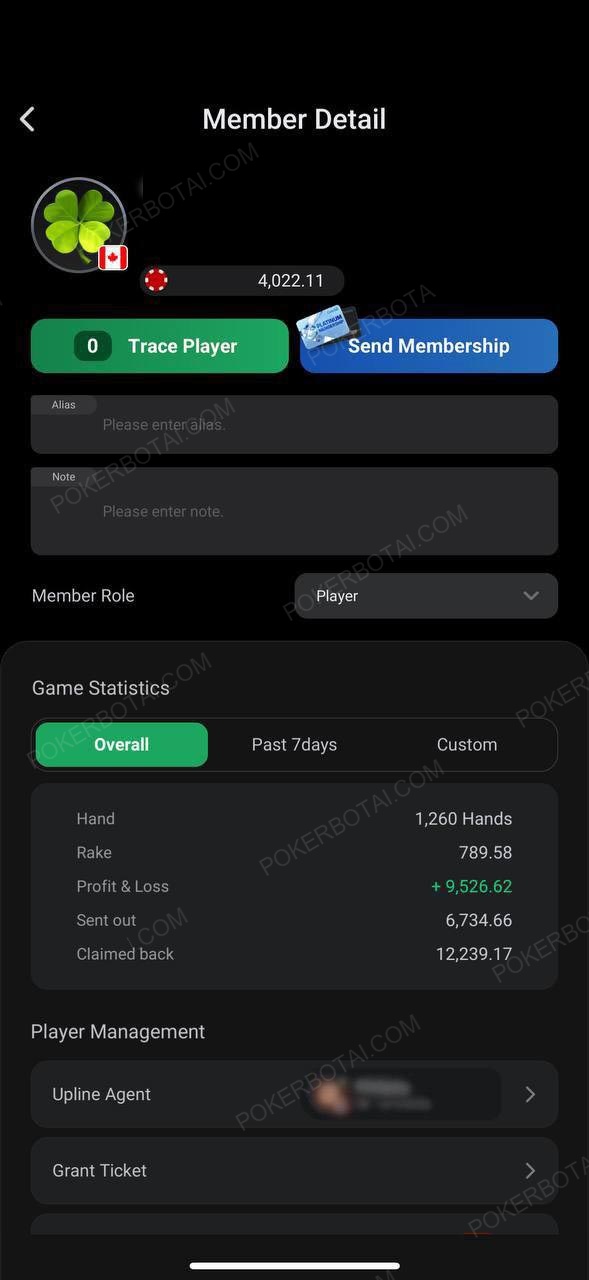
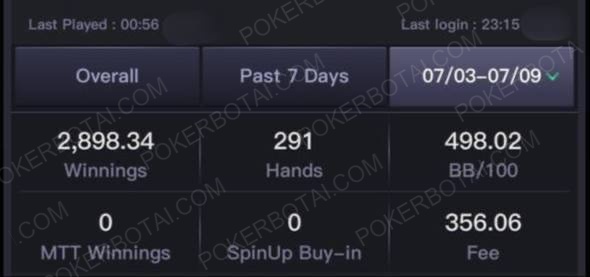
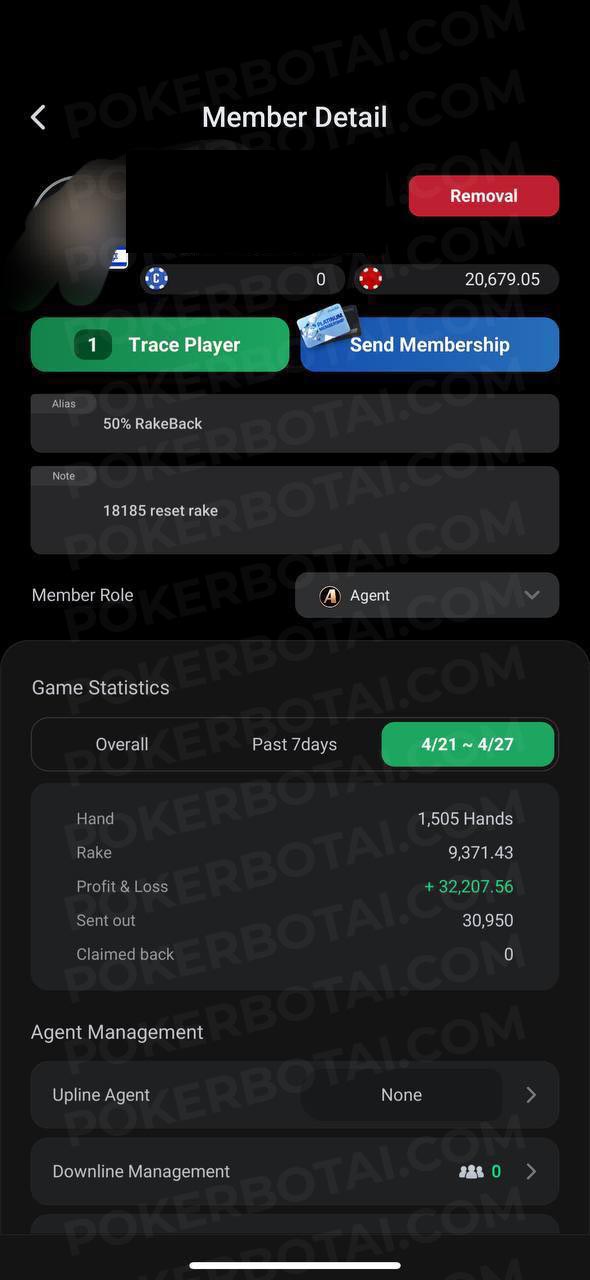
Beyond fuel ROI cases, here’s real data some partner clubs have shared, backed by the screenshots below. Note: these are exceptional, high-volume multi-account club operations — not what a typical individual user earns, and your own results will differ:
- PPPoker, daily results: profit of $2,383-$9,103 per day (average ~$4,500/day) running multiple accounts
- ClubGG / PokerBros, agent model: $11,343-$18,570 win per week + $16,900-$26,300 rake per week
- Client with 6 accounts at low-mid stakes: $34,500/week (win + rakeback), 12,000 hands
Here is what these results look like in practice — actual screenshots from partner accounts:
ClubGG player: +9,526 USD in 1,260 hands (weekly result)
PokerBros bot account: 498 BB/100 over 291 hands ($2,898 profit in one week)
ClubGG agent: +32,207 ILS in 1,505 hands over one week (agent with 50% rakeback)
Growth statistics over distance
Data for the average partner with a 17 bb/100 winrate:
| Sample | Profit (BB) | Note |
|---|---|---|
| 10,000 hands | ~1,700 BB | High variance |
| 50,000 hands | ~9,000 BB | Results stabilize |
| 125,000 hands | ~19,000 BB | Clear trend |
| 240,000 hands | ~39,000 BB | Variance smoothed |
At NL25 that translates to:
-
50K hands: ~$2,250
-
125K hands: ~$4,750
-
240K hands: ~$9,750
At NL50, double it. At NL100 — double again.
Field temperature impact: why this is the main factor
Winrate comparison by field type (field temperature)
| Field Type | Characteristics | Expected Winrate |
|---|---|---|
| Soft | VPIP 40%+ for 3+ players | 25-35 bb/100 |
| Medium | VPIP 30-40% for most players | 15-25 bb/100 |
| Tough | VPIP < 25%, many regulars | 5-15 bb/100 |
| Toxic | Regulars, bots | 0-5 bb/100 or negative |
The difference between a soft and tough field is 20+ bb/100. Over a 100,000-hand sample:
-
NL25: $5,000 difference
-
NL50: $10,000 difference
-
NL100: $20,000 difference
How to find soft fields
Ideally, you should have personal experience playing at a specific club or platform to understand the player pool — who are the fish, regulars, bots, and so on. If it’s a new venue for you, start by gradually introducing bots and closely monitoring results and statistics.
TableSelect analyzes table composition and shows profitability using hundreds of parameters. 3-color indication (not available for all rooms):
-
Green — high profit, join
-
Yellow — low profit, worth trying
-
Red — loss, skip
Manual criteria:
-
At least 1 player with VPIP 40%+ (NLH) or 50%+ (PLO)
-
No known regulars
-
Average stack < 150 BB (fish don’t rebuy)
-
Active limping and cold-calls
Warning: Don’t sit at a table without an obvious fish. Playing “reg vs reg” is a fight for scraps with high variance. Better to spend time finding a soft table.
Stack depth impact on ROI
Stack depth directly affects AI winrate:
| Stack Depth | Winrate (bb/100) |
|---|---|
| < 100bb | ~24 |
| 100-200bb | ~31 |
| 200-300bb | ~41 |
| 300-400bb | ~44 |
| 400bb+ | ~44 |
With deep stacks, the AI executes complex lines that are impossible with short stacks. Opponent mistakes cost more.
Note: Optimal range: 200-450bb. If the stack grows above 500bb — lock in the profit and switch tables. Stacks that are too deep increase variance.
Conclusion: play with 200+ BB. If the stack grows to 400-500 BB — lock in the profit.
Calculating expected ROI: step-by-step guide
Step 1: determine costs
| Item | Amount/mo |
|---|---|
| Fuel (estimate) | $_____ |
| Proxies (if needed) | $_____ |
| VPS/Server | $_____ |
| Total: | $_____ |
Step 2: determine play parameters
-
Stakes: NL_____
-
BB size: $_____
-
Expected winrate: _____ bb/100
-
Profit per 100 hands: $_____ (winrate x BB)
Step 3: calculate break-even
Step 4: determine play volume
-
Tables: _____
-
Hands/hour/table: ~60
-
Hours of play/day: _____
-
Hands/month: tables x 60 x hours x 30
Step 5: calculate expected profit
Example calculation
Inputs:
-
Stakes: NL25, BB = $0.25
-
Winrate: 25 bb/100
-
Profit per 100 hands: $6.25
-
Costs: $475/mo (fuel at minimum rates)
-
Tables: 6
-
Hours/day: 4
-
Hands/month: 6 x 60 x 4 x 30 = 43,200
Calculation:
-
Gross profit: 43,200 x $6.25 / 100 = $2,700
-
Net profit: $2,700 – $475 = $2,225
-
ROI: $2,225 / $475 x 100% = 468%
Realistic expectations by operation scale
Micro operation (1-3 accounts)
-
Costs: $300-500/mo
-
Expected profit: $300-1,500/mo
-
ROI: 50-300%
-
Risks: High dependence on one or two accounts
Small operation (5-10 accounts)
-
Costs: $500-1,000/mo
-
Expected profit: $1,500-4,000/mo
-
ROI: 200-400%
-
Risks: Moderate, diversification helps
Medium operation (15-30 accounts)
-
Costs: $1,000-2,000/mo
-
Expected profit: $3,000-8,000/mo
-
ROI: 200-350%
-
Risks: Requires a systematic management approach
Large operation (50+ accounts)
-
Costs: $3,000-5,000/mo
-
Expected profit: $8,000-20,000/mo
-
ROI: 150-300%
-
Risks: Requires a team, automation, strict processes
The bigger the scale — the lower the margin in percentage terms, but the higher the absolute profit.
Scaling limits: why you can’t grow indefinitely
Limited number of recreational players
Bot profitability depends on the presence of weak players (recreational players, fish). Their number on any platform is finite. If you launch too many bots in one club or on one platform, sooner or later they’ll start playing against each other rather than against fish — and the winrate will drop to zero or go negative.
Seasonality and field dynamics
- The number of active players changes throughout the year (peaks: holidays, weekends; dips: weekdays, summer months)
- Recreational players come and go: some get discouraged after losses, new ones appear
- Regulars constantly improve their game and adopt more advanced tools
- The field evolves — what worked 6 months ago may not work now
The Balance Principle
We recommend maintaining balance: bots should make up no more than 20-30% of the total active players in a club. This ensures stable profitability without killing the ecosystem.
Alternative for Club Owners: Poker Ecology
If you’re a poker club owner interested in the long-term health of your platform, we offer the Poker Ecology service:
- Starting tables and creating 24/7 activity — the club looks alive and attracts new players
- Balancing the ecosystem: bots are configured to maintain balance, not maximize profit. Recreational players don’t drain their deposit in an hour, regulars get worthy opponents
- Working on a partnership model — win and rake are split by agreement. The service is available only for poker business owners
- Built-in detection: the PokerBotRadar system identifies suspicious external bots and collusion in your club
- Preserves the club’s appeal for recreational players
- Doesn’t create a “dead field” where only bots play
- Benefits the poker community and doesn’t have a destructive impact on the online poker industry
More about the service: contact us on Telegram @PokerBotAI_ShopBot
For agents and players: If you’re not a club owner but want to earn without operational work — there’s the TurnKey PokerBotFarm (The Deal) format. PokerBotAI launches and manages the bots, you provide access and the deposit, profits are split by agreement.
TurnKey PokerBotFarm (The Deal)
How to boost your ROI: practical recommendations
1. Choose clubs and tables, NOT rooms
A room with a “soft field” is useless if you’re sitting at a table with regulars. Use TableSelect, analyze opponent VPIP, don’t be lazy about switching tables.
2. Follow AI hints 100% in manual mode
Every deviation from the AI recommendation is lost EV. The system is trained on 7+ billion hands (synthetic and solver data). Your intuition is based on a few thousand. The math is obvious.
3. Maintain optimal stack
Play with 200+ BB. Bankroll of 50+ bb, recommended 100-200bb+. If the stack grows to 400-500 BB — lock in the profit.
4. Scale wisely
Three bots at low stakes is better than one bot at high stakes. Each additional bot at a table significantly increases your winrate. Each new account = new proxy, new IP, new risks. Account rotation: 5-28 days or 3-15K hands.
5. Factor bans into the economics
Budget 10-15% of expected profit for ban losses. Don’t keep more than 3 buy-ins on one account. Withdraw regularly, in small amounts.
What to expect: beginner’s timeline
| Period | What Happens |
|---|---|
| Week 1 | Setup, test sessions, learning the interface |
| Weeks 2-3 | First 5-10K hands, swings are possible, don’t panic |
| Month 1 | 15-25K hands, real trend starts to emerge |
| Month 2 | 50K+ hands, ROI becomes predictable |
Note: The first month is an investment in learning. Don’t judge the system’s potential by it. The real picture emerges after 50,000 hands.
Conclusion: key takeaways
-
200-400% ROI is realistic. But it requires the right field, discipline, and infrastructure.
-
Distance matters. 5,000 hands is noise. 50K+ hands is a trend. Don’t draw conclusions prematurely.
-
Field matters more than stakes. A soft field at NL10 is more profitable than a tough field at NL50.
-
Follow AI hints in manual mode. Every deviation from the recommendation is lost EV.
-
Scale lowers margins but increases absolute profit. 218% ROI on $3,520 costs = $11,200 profit. Better than 400% on $500. More bots = more total income.
-
If your room requires proxies, invest in quality. Cheap datacenter proxies → bans → losses. Many rooms don’t check IPs — home or mobile internet works fine and costs nothing.
-
Deep stacks (200+ BB) unlock the system’s potential.
-
Bans are part of the economics — factor them into your calculations.
How Much Do Poker Bots Cost + Solution Comparison
Types of Poker Bots: How They See, Click, Think, and Decide
How Rooms Catch Bots: Detection Methods 2026
Masking Best Practices + Launch Checklist
TurnKey PokerBotFarm (The Deal)
Calculate your potential ROI
Use the profit calculator for a personalized estimate: pokerbotai.net/est-profit
ROI envelopes by network
Realistic win-rate bands vary across networks. The room-specific writeups below cover illustrative envelopes for the most-asked-about pools in 2026:
- PokerX NLH engine — our shipping NLH product, with delivered results across NL10–NL400 6-Max and full-ring.
- Ignition Poker — anonymous-table envelope on the PaiWangLuo Network for US/Australia.
- Bovada Poker — Ignition’s US-focused sister site, same network, largest US-facing pool.
Try the AI poker bot for free
Test fuel for new users — evaluate real results on your field at no cost.
Contact us: @PokerBotAI_ShopBot
Consultants will help calculate expected ROI for your situation and select the optimal configuration.
Related: Pokerrrr 2 bot.