Variance and sample size: why results are deceiving
You launched the bot, played 500 hands — and ended up in the red. Does that mean the bot is unprofitable? No. It means you don’t yet understand how poker works over the long run.
This article is for those who want to understand why short-term results lie, what variance is, and why a bot with positive EV inevitably comes out ahead over a large enough sample.
Why a single session means nothing
- Imagine flipping a coin. Heads — you get $2. Tails — you lose $1. Mathematically, this is a profitable game: expected profit of +$0.50 per flip.
- But you flip the coin 10 times — and tails comes up 7 times. You’re down $5. Does that mean the game is unprofitable? Of course not. You just got unlucky over a short sample.
- Poker works exactly the same way — except instead of two outcomes there are thousands, and randomness affects every hand.
What is variance
Variance is the deviation of actual results from mathematical expectation.
In simpler terms: you can play perfectly and lose. Or play poorly and win. Over a short sample, randomness is stronger than skill.
Here’s what variance does to results:
-
You go all-in with A♠A♥ against 7♦2♣ — one of the weakest hands in poker. You have 87% to win. But 13% of the time you’ll lose — and if that happens 3 times in a row, your graph will plunge even though you did everything right
-
Your opponent calls your river bluff — and hits their 5% out. That’s minus one stack. But the decision was correct
-
You fold a medium-strength hand against an aggressor — they show a bluff. Seems like a bad fold. But over the long run, that fold is profitable
Variance doesn’t like short samples. The fewer hands you play, the greater the chance that randomness will distort the real picture.
What is “the long run” and why it matters
The long run is the number of hands played that’s sufficient for randomness to “average out” and reveal your true level of play.
How many hands you need for a reliable assessment:
Where do these numbers come from? From statistics. Poker is a high-variance game: standard deviation (the spread of results) is typically 60-100 BB/100 hands. To separate the real win rate from randomness, you need a sample where the confidence interval becomes narrow enough. With a win rate of ~15 BB/100 and a typical deviation of ~80 BB/100, you need roughly 50,000 hands to say with 95% confidence that the result isn’t due to chance. This is the standard statistical model used by poker trackers and analysts worldwide — based on confidence interval methodology applied to high-variance games. The poker community references this approach in tools like Primedope’s variance calculator, which lets you simulate win rate confidence intervals for any sample size.
EV vs actual results: what’s the difference
Here’s where the key concept comes in — EV (Expected Value), the expected profit.
-
BB/100 (Big Blinds per 100 hands) — your actual result. How much you actually won or lost
-
EV BB/100 — your expected result based on decision quality
The difference between them shows whether you’re running good or bad:
The bot makes decisions based on EV. Every action is calculated to maximize expected profit — regardless of how the cards fall in any particular hand.
| Situation | What It Means |
|---|---|
| EV BB/100 > BB/100 | You’re running bad. You’re playing better than the graph shows |
| EV BB/100 < BB/100 | You’re running good. Results are better than your actual level |
| EV BB/100 ≈ BB/100 | Variance has smoothed out. You’re seeing your real win rate |
Real case study: from zero to 41 BB/100
Here’s data from an actual PokerBotAI user:
-
First 5,000 hands — near-zero results, graph slightly in the red
-
From 5,000 to 15,000 hands — unstable swings, moments of frustration
-
The EV line was climbing steadily upward the entire time
-
Final result at 20,000 hands: win rate of 41 bb/100, EV of +14,000 BB
What happened? In the first 6,000 hands, the bot was losing all-ins with the best hands. The cards ran against it. But the decisions were correct — and EV showed it.
As the sample grew, variance smoothed out. The actual result “caught up” with the EV line.
Variance in real data: weekly BB/100
Here are actual weekly BB/100 figures from several accounts on PPPoker (data from private clubs):
| Account | Hands per Week | BB/100 |
|---|---|---|
| A | 291 | 498 |
| B | 194 | 443 |
| C | 266 | 193 |
| D | 387 | 217 |
| E | 232 | 198 |
| F | 94 | 582 |
BB/100 ranges from 193 to 582 — a 3x spread! And this is data from the same AI on the same platform. The reason is the tiny sample (94-387 hands). Over 200 hands, variance dominates skill. If these same accounts had played 50,000 hands each — the spread would compress to a predictable range.
This is exactly what we’re talking about: a short sample shows anything. One account looks like a “monster” at 582 BB/100, another “only” 193 BB/100. In reality — it’s the same bot, the cards just fell differently.
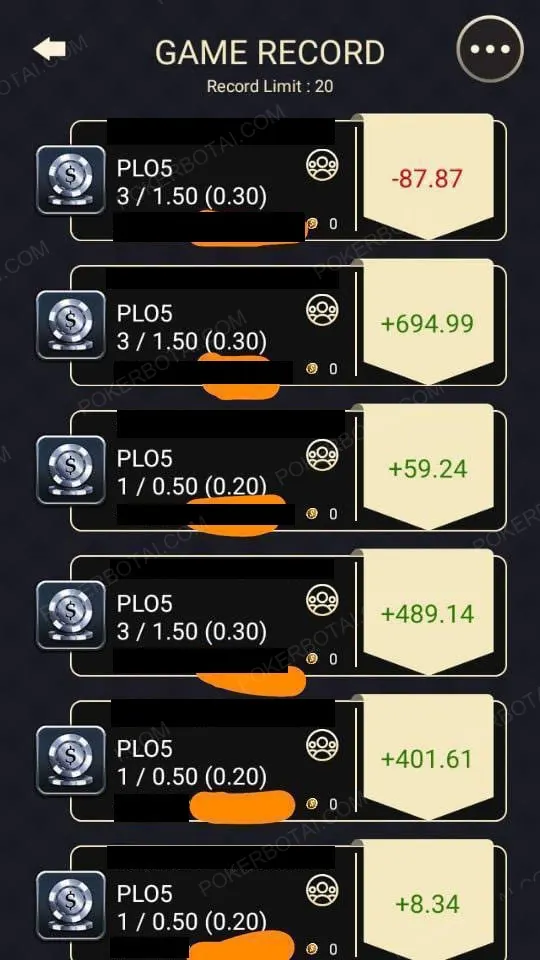
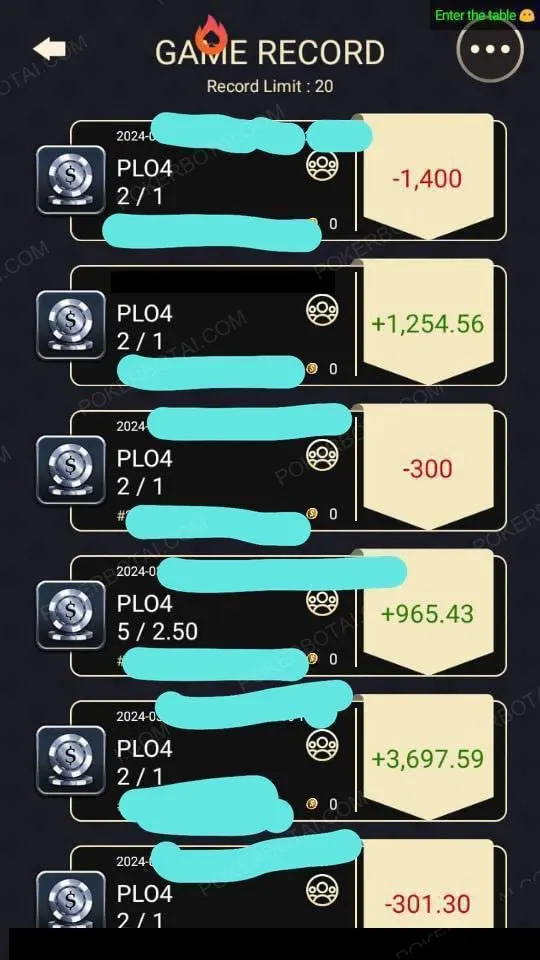
The same pattern holds across platforms and game types. Here are session-level results from a Pokerrrr2 player — wins and losses alternate naturally, even with a profitable bot:
PLO5 sessions on Pokerrrr2 (USD): results swing from -87 to +694 within days
PLO4 sessions at higher stakes: swings from -1,400 to +3,697 in a single week
Why the bot inevitably comes out ahead
Behind every bot decision is not a guess but a calculation. PokerBotAI’s neural network is trained on billions of game situations and knows which action yields the maximum EV in every specific spot. It’s like an experienced player who has “seen it all” — only without fatigue, emotions, or memory errors.
Over short stretches, variance can outweigh everything. But the more hands you play, the stronger the law of large numbers works:
-
Random deviations cancel each other out
-
Mathematical expectation materializes
-
Positive EV converts into real profit
The bot doesn’t get tired, doesn’t tilt, doesn’t make emotional decisions. Every hand is a cold probability calculation.
“Poker is a marathon, not a sprint. The more hands you play, the less luck matters.”
How long until you see results
| Number of Hands | Assessment Reliability | What You Can Learn |
|---|---|---|
| 1,000 – 5,000 | Very low | Nothing. Just emotions |
| 10,000 – 30,000 | Low | A trend, but with a large margin of error |
| 50,000 – 100,000 | Medium | Real win rate begins to emerge |
| 150,000+ | High | You can draw conclusions about play quality |
Specific numbers based on user statistics:
- These figures assume an average win rate of 10-40 BB/100 (depending on the room, stakes, field quality, and volume). The range is wide because conditions vary significantly: at weak club tables the bot extracts maximum value, while against a tough regular field it’s closer to the lower end.
- For comparison: according to the largest poker tracking databases (SharkScope, PokerTracker), a good human regular at micro and low stakes maintains 5-8 BB/100, and top professionals hold 10-15 BB/100 over long samples. A win rate above 10 BB/100 over 100K+ hands is considered elite-level among humans.
| Sample Size (hands) | Average Profit (BB) |
|---|---|
| 50,000 | ~9,000 BB |
| 125,000 | ~19,000 BB |
| 240,000 | ~39,000 BB |
Exceptions: when the bot might NOT come out ahead
To be honest: there are situations where even a good bot will face challenges.
- Targeted Play Against Bots
Some experienced players can identify bots by their patterns and deliberately exploit their strategies. If someone at the table understands how the bot works — they will adapt.
However, PokerBotAI addresses this:
-
Adaptive strategy — the bot doesn’t play “one line,” it adjusts to opponents
-
Action randomization — timing, sizings, bluff frequencies all vary
-
TableSelect — analyzes the table composition and rates its profitability. The rating is based on opponents’ statistical profiles: VPIP, PFR, aggression, fold frequencies, and other metrics. The more players at the table with deviations from optimal strategy (too loose, passive, predictable) — the higher the table rating. Green indicator — the field is weak, it’s profitable to play. Red — strong regulars, better to move
-
Team play defense — when you run 2-3+ bots at the same table, they implicitly protect each other: an opponent trying to target one bot faces pressure from others, making exploitation much harder
- An Overly Tough Field
If the table has only strong regulars and no weak players (fish), rake eats into profits. The bot will show a black indicator in TableSelect — that’s a signal to leave the table.
- Ignoring Bot Recommendations
In manual mode, if you regularly deviate from the AI’s suggestions — you’re breaking the chain of +EV decisions. Every deviation = a portion of profit you’re handing to your opponent.
- Collusion / Team Play
Yes, this happens too. Either several players or bots are working together and know each other’s cards. In such cases we generally recommend leaving the table immediately and moving to more profitable ones.
How to properly evaluate results
Checklist for a sound assessment:
-
Focus on the long-term trend, not the balance after a single session. The PokerBotAI dashboard shows key metrics — total profit, number of hands, win rate. Important: for security reasons we don’t support third-party trackers (Hand2Note, etc.) — this protects your accounts from hand history leaks. All necessary data is available in the bot’s interface
-
Measure in BB/100, not dollars. This makes comparisons between stakes fair
-
Don’t panic over losing sessions. If after 5,000 hands the result is negative — reach out to us and we’ll analyze the situation: you may need to switch clubs, stakes, or settings. But individual losing days are a normal part of poker, even for the best players in the world
-
Monitor the “quality” of your tables. Profit depends not just on the bot but on your opponents
-
Keep track of session stats. The PokerBotAI dashboard shows all metrics in one place
Takeaways
-
Short-term results are noise. A single 1,000-hand session, sometimes even an unlucky 5,000-hand stretch — is not enough for conclusions
-
Variance is real. You can play perfectly and lose. That’s normal
-
EV is your compass. Follow it, not the balance after each session
-
50K+ hands is the minimum for an honest assessment. Everything else is emotions
-
A bot with +EV inevitably comes out ahead over the long run. Math doesn’t lie
Poker isn’t about instant wins. It’s about systems, not lucky streaks. The bot gives you a system. Your job is to give it the sample size.
Related articles
“EV and Equity: Why the Bot Doesn’t Care About Luck” — the mathematical foundation of decisions
“How Bots Think: Decision Trees in Plain Language” — the logic of AI decision-making
“GTO Strategy: Why the Bot Becomes Invincible” — why GTO works over the long run
Pot Odds and Implied Odds in 5 Minutes