Choosing the right room and stakes
Not all poker platforms are created equal. Some offer soft fields and weak anti-bot controls, others have aggressive moderation and regulars at every table. The winrate difference between rooms can reach 20-30 bb/100. Choosing a platform is no less important a decision than choosing the bot itself.
This article is for those who already understand the basic mechanics of poker bots and want to figure out where exactly to launch their farm.
Three types of platforms: a brief overview
The 2026 poker market is divided into three categories. Each has its own characteristics, risks, and potential for bots.
Major networks (GGPoker, 888poker, ACR, and others)
Major networks attract with traffic and liquidity. GGPoker is the world’s largest platform (record: 600,686 peak players in September 2025). But the larger the platform, the more serious the resources dedicated to fighting bots — behavioral analysis, verification, machine learning for pattern detection.
The field is tougher and more competitive, which means thinner margins — but major networks also offer massive traffic and stable payouts. Some major networks (GGPoker, 888poker, ClubGG) are supported by PokerBotAI and can be very profitable with the right approach to masking and table selection.
Local rooms (regional operators)
Small regional platforms often have weak anti-bot controls. But liquidity is limited — there may not be enough tables for scaling.
Club apps (PPPoker, WePoker, X-Poker, PokerBros, Suprema, Pokerrrr 2)
The sweet spot. Club apps operate on a private club model: agents create clubs, players join by invitation. Anti-bot moderation varies from club to club, the field is on average softer and more diverse than in major networks.
Club apps show the best results for bots in 2026.
Our users’ data confirms this in practice: consistent results are recorded on PPPoker, PokerBros, ClubGG, Suprema, X-Poker, Pokerrr2, and other apps. In exceptional cases, one client on PPPoker has recorded days of $2,300-$9,100 playing multiple tables — but these are peak results, not daily averages. On PokerBros and ClubGG, best weekly results of $11,000-$18,000 have been recorded in favorable conditions. Results depend on Field Temperature: if the club has low traffic and small money (cold field) — profits will match. A hot field with high VPIP and recreational players delivers maximum winrate.
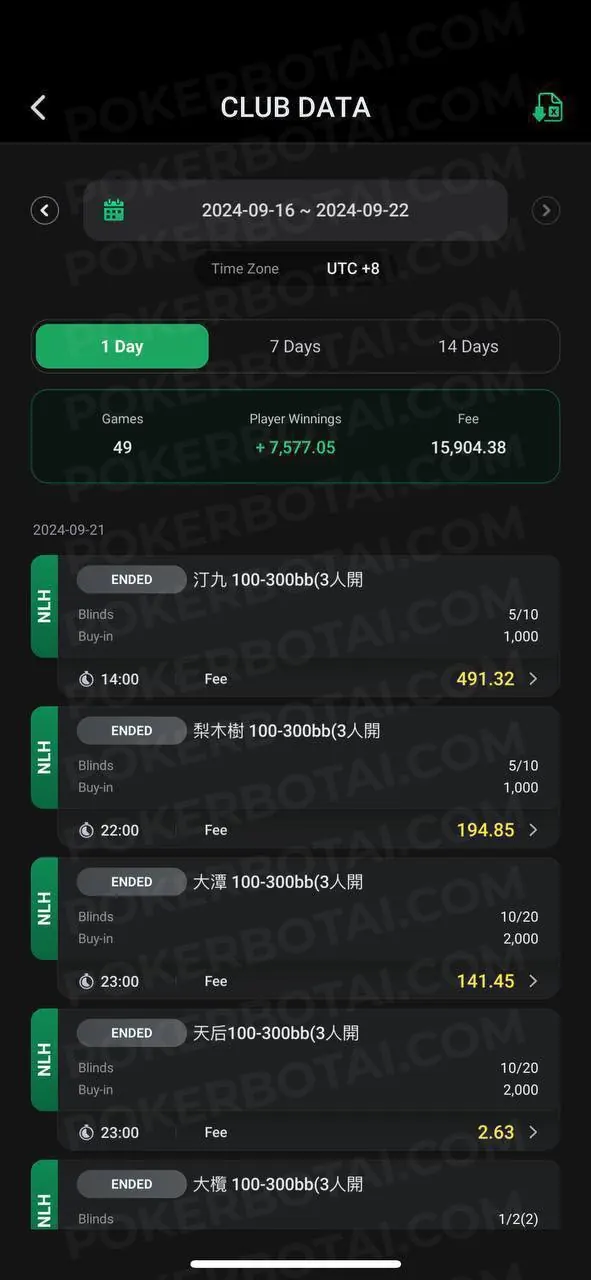
Weekly data from one ClubGG club (HKD): 49 tables, +7,577 player winnings, 15,904 in fees. Multi-club operations aggregate results from several such clubs.
Winrate comparison by room
Here are real EVbb/100 statistics by platform over a sample of 150K+ hands (data as of end of 2025 — numbers may change as the market evolves):
| Room | EVbb/100 | Actual bb/100 | Field | Anti-bot |
|---|---|---|---|---|
| WePoker | ~56 | 32 | Soft | Weak |
| HHPoker | ~47 | 29 | Medium | Medium |
| Pokerrr2 | 25-32 | 25-32 | Soft | Weak |
| PokerBros | 27-30 | 27-30 | Medium | Medium |
| PPPoker | 28-29 | 28-29 | Medium | Medium |
| ClubGG | 20-28 | 20-28 | Medium | Medium |
| X-Poker | 20-29 | 20-29 | Tough | Strict |
Note the gap between EVbb/100 and actual winrate. This is variance: over short samples it distorts results. More on this in the article Variance and Distance: Why Results Are Misleading
Club apps: why they lead
Club apps dominate our statistics for good reason. Several factors:
- Audience Structure
Club apps attract players through agents — often recreational players who want to play with friends. VPIP 60+ here is not unusual but the norm. For a bot, this kind of field is the ideal environment.
- Decentralized Moderation
Each club is moderated separately. There’s no unified anti-bot detection system like major networks have. A club owner may turn a blind eye to a suspicious player if they’re generating rake.
- Scalability
Many club rooms, with hundreds and thousands of clubs in each. If one club closes or bans an account — there’s somewhere to go.
Beyond ban risks, there are financial risks with the clubs themselves. Recent examples:
- Diamond Union (PPPoker): union collapse with player losses of ~$4M. Player funds were locked after the shutdown.
- Apex Union (PPPoker): exit scam for ~EUR 5M. The union organizers disappeared with players’ money.
The lesson: diversify across clubs and platforms, and withdraw funds regularly.
Choosing stakes: why micros aren’t always the right start
Common logic: “I’ll start at micro stakes, the risks are lower.” The logic makes sense, but it’s not always correct.
Problems with micro stakes
- Low absolute profit. 30bb/100 at NL2 is $0.60 per 100 hands. To earn $1,000, you need to play 166,000 hands. At NL25, the same winrate yields $7.50 per 100 hands — 12x more.
- Same resource expenditure. Emulator, proxy (if needed), electricity, time — all cost the same regardless of stakes. ROI at micro stakes can be negative.
- Unrepresentative field. At micro stakes there are many bots and regulars “grinding from zero.” The field can be tougher than at NL10-NL25.
Optimal range
For most operations, we recommend NL10-NL50:
| Stakes | Characteristics | Suitable For |
|---|---|---|
| NL2-NL5 | Minimal risk, low profit | Testing settings |
| NL10-NL25 | Balance of risk and profit | Primary operation |
| NL50-NL100 | Higher profit, requires bankroll | Scaling |
| NL200+ | High variance, tough field | Only with experience |
Poker Bot ROI: Realistic Expectations
Stack depth: the hidden winrate factor
Stakes aren’t the only variable. Stack depth directly affects AI performance.
Statistics from HHPoker:
| Stack Depth | Winrate (bb/100) |
|---|---|
| < 100bb | ~24 |
| 100-200bb | ~31 |
| 200-300bb | ~41 |
| 300-400bb | ~44 |
| 400bb+ | ~44 |
The difference between playing with a short stack (<100bb) and deep (300-400bb) is about 20 bb/100. This isn’t a statistical anomaly — it’s a fundamental advantage.
Why does this happen? Deep stacks provide more room to maneuver. The AI can execute complex lines that are impossible with short stacks. Against weak players, this is critically important — their mistakes cost more with deep stacks.
Table format: 6-max vs 9-max vs heads-up
Recommendation: 6-max or 9-max
At full tables, the bot plays in its element. More opponents means more information for the AI. More hands per hour means the advantage accumulates faster.
Why we don’t recommend heads-up
HU (one-on-one play) is a format with maximum variance and unpredictability. Here’s why:
Variance Math: At a full table (6-9 players), you participate in ~20-30% of hands, and results average out across multiple opponents. In HU, you play 100% of hands against a single opponent — every mistake or lucky break has a bigger impact. Variance (standard deviation of results) in HU is 3-4 times higher than at a full table.
Difficulty Reading the Opponent: In a 1-on-1 format, VPIP 60-80% is the norm, not a sign of a weak player. It’s harder for the AI to distinguish a fish from an experienced HU regular, since both play aggressively and wide.
Competition: Soft HU tables get taken instantly, and strong regulars hunt for weak players.
TableSelect: how AI chooses tables for you
Manual table selection works but doesn’t scale well. At scale, you need automation.
TableSelect analyzes the table composition and shows profitability using three colors (not available for all rooms):
-
Green — high profit, sit down immediately
-
Yellow — low profit, worth trying
-
Red — potential loss, better to skip
The system accounts for hundreds of parameters and table composition combinations. This isn’t just VPIP counting — it’s a full table dynamics analysis.
Practical platform selection recommendations
For beginners (first bot)
-
Platform: start with a platform where you usually play (you know the specifics), or club rooms
-
Game type: NLH or PLO — choose where the field is softer and you’re more comfortable
-
Stakes: depends on your deposit size — follow the 40+ buy-in bankroll rule (e.g., for NL10 you need $400, for NL25 — $1,000)
-
Format: 6-max or 9-max (more players = more stable results)
-
Stack: from 100bb+, recommended 100-200bb
The main thing: make sure you have enough bankroll to survive variance. Even with a positive winrate, you can lose 10-20 buy-ins in a row. If you start at stakes that are too high with a small deposit, there’s a chance you’ll lose everything within 1,000 hands and start blaming us 🙁
For scaling (50+ accounts)
-
Platforms: several club platforms + optionally a centralized room (diversification)
-
Game type: NLH, PLO, Bomb Pot, ROE — play where the field is soft and diverse. Modifiers like Bomb Pot add variance but also create more opportunities against weak opponents
-
Stakes: depend on your total bankroll and risk management skills
-
Stack: 200-400bb (optimal for maximum winrate)
Diversification across rooms reduces risks. If one room or club tightens moderation — the rest keep working.
For aggressive growth
-
Platforms: pick 3-5 base rooms with high traffic, focus not only on playing in public lobbies and clubs but also on building and growing your own clubs and agent network
-
Game type: everything that generates volume and profit — NLH, PLO, OFC, Pusoy, Mau Binh, MTT, any formats with soft fields (exotic formats are not supported on all rooms — check with us)
-
Stakes: determined by your bankroll and willingness to handle variance (for high stakes you need a reserve of 80-100 buy-ins)
-
Automation: Auto Mode + Admin Panel (automation and management of multiple bots via web)
What to avoid
Some platforms create more problems than they generate profit:
- Major networks with strict verification. Platforms at the GGPoker and PokerStars level use AI for bot detection and video verification. Playing is possible, but requires maximum attention to masking and security.
- Platforms with centralized monitoring. If a room has a unified pattern-tracking system across all accounts — banning one account can pull the rest down with it.
- Dead clubs. A club with 2 tables and 10 online players won’t provide volume. Look for clubs with active traffic — at least 10 tables at your desired stakes.
- Unsupported platforms. If a room isn’t on the PokerBotAI supported list — there are reasons for that. Check the current platform list with our team.
- “Suspicious” clubs with low host trust. Risk of not just a ban, but also non-payment of winnings. Research the host’s reputation before joining: reviews, track record, known exit scam cases.
- Huge clubs with strict controls. Large clubs often apply strict verification and constant checks — this increases ban risk.
Conclusion: key takeaways
-
Club apps lead and show the best winrates
-
Micro stakes are not a cure-all — the optimal range is NL10-NL50
-
Stack depth matters — the sweet spot is 200-400bb
-
6-max/9-max with full tables is optimal — more information for the AI, easier to find profitable tables
-
Diversification reduces risks — work with multiple clubs and rooms simultaneously
Choosing a platform is not a one-time decision. The market changes, rooms tighten or loosen controls, clubs open and close. Monitor your account statistics and be ready to adapt.
Multi-Tabling with Bots: Risks and Optimization