Poker Bot Farm: What It Takes to Run One in 2026
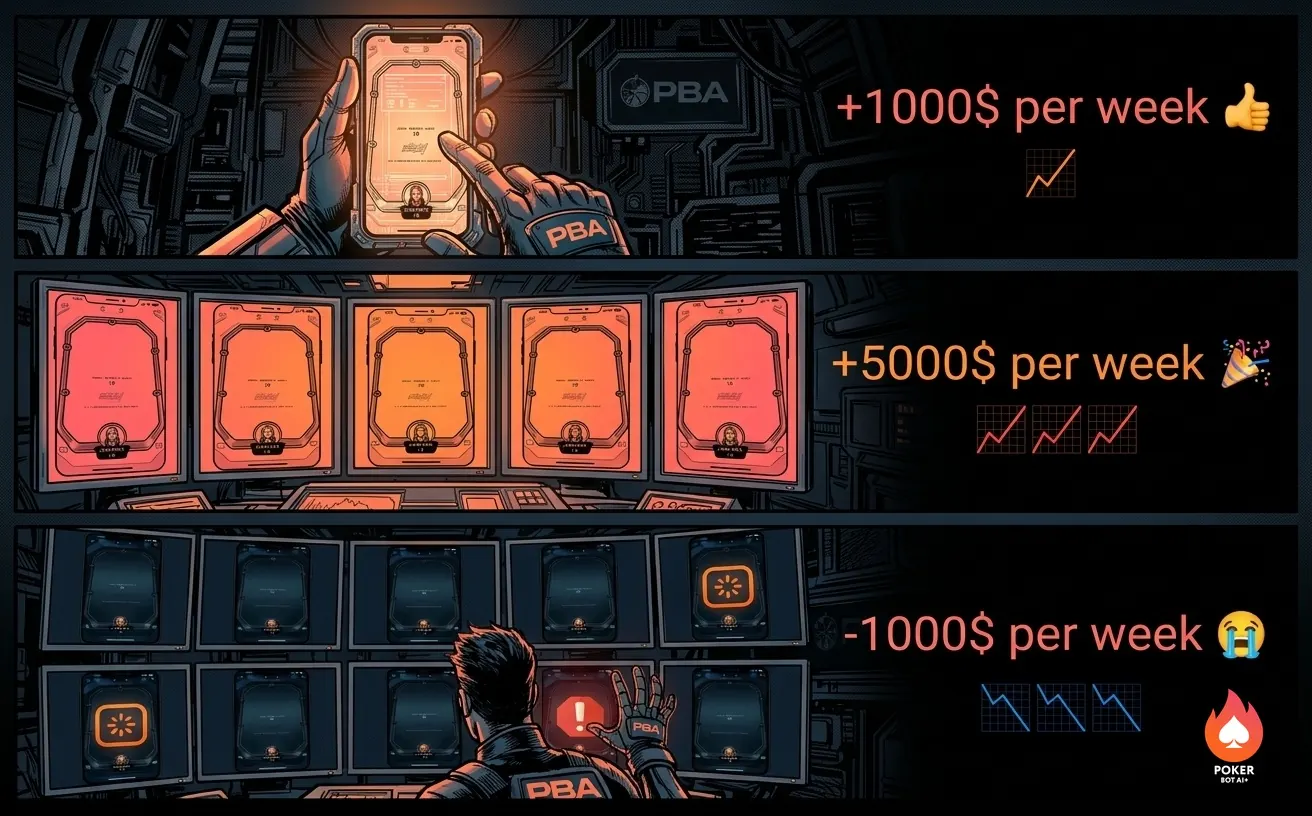

When people hear about poker bot farms, they often imagine an automatic money-making machine: launch the software, fund the account, then cash out the profits. In 2026, it doesn’t work that way. A poker bot farm isn’t a “get-rich-quick” scheme, but a complex system in which software and AI are just parts of the whole.
This is exactly where many people make the same mistake: they find a strong bot and think that’s enough to set up a farm. But even the best AI and software won’t help if the rest of the setup is poorly constructed. There are many vulnerabilities in such a system, and it’s precisely these that most often cause beginners to lose money.
In this article, I want to take a realistic look at what a bot farm actually entails in 2026: why you can’t think solely in terms of numbers and calculations, what mistakes beginners most often make, and what you can do to avoid repeating them.
What Is a Poker Bot Farm in 2026
The biggest misconception in this topic is thinking that a bot farm is simply scaling up a single successful solution. Beginners’ logic is usually straightforward: if one bot with a good “brain” has made money over the long run, then a hundred such bots will make a hundred times more. On paper, this looks great. In reality—almost never.
A hundred bots are not just one bot repeated a hundred times. A single bot operates in almost sterile conditions: you have complete control over the situation, quickly notice glitches, and can manually smooth out problems. All attention is focused solely on it. But as soon as we’re talking not about one, but even just ten accounts, issues start to surface that are almost invisible at the single-bot level. Scaling in this field isn’t about multiplying revenue. It’s about multiplying points of failure.
That is exactly why you cannot chase quantity here. First, you need to build a system where you understand what is happening at every level. Otherwise, instead of a functioning structure, you get a completely different result: frozen funds, wasted time, technical chaos, and a very quick sobering-up.
I’ve seen people lose money time and again, even though they seemingly had everything they needed to turn a profit. They had the software, the resources, the passion, and the expectations. The only thing missing was the most important part—discipline and the understanding that sustainability in this business is more important than flashy calculations at the start.
The sooner a person stops romanticizing scaling, the better for them. The reality here is far more prosaic: increasing the number of accounts does not in itself guarantee comparable income growth. And with poor organization, it easily wipes out the results that could have been achieved, or worse, turns profits into losses.
What the entire system actually consists of
When people talk about a bot farm, many habitually boil it all down to the quality of the AI and the gaming software. But in practice, a farm doesn’t rely on a single “smart” component, but on the entire system as a whole. And the weak spot in this system is almost always found not where a beginner looks first.
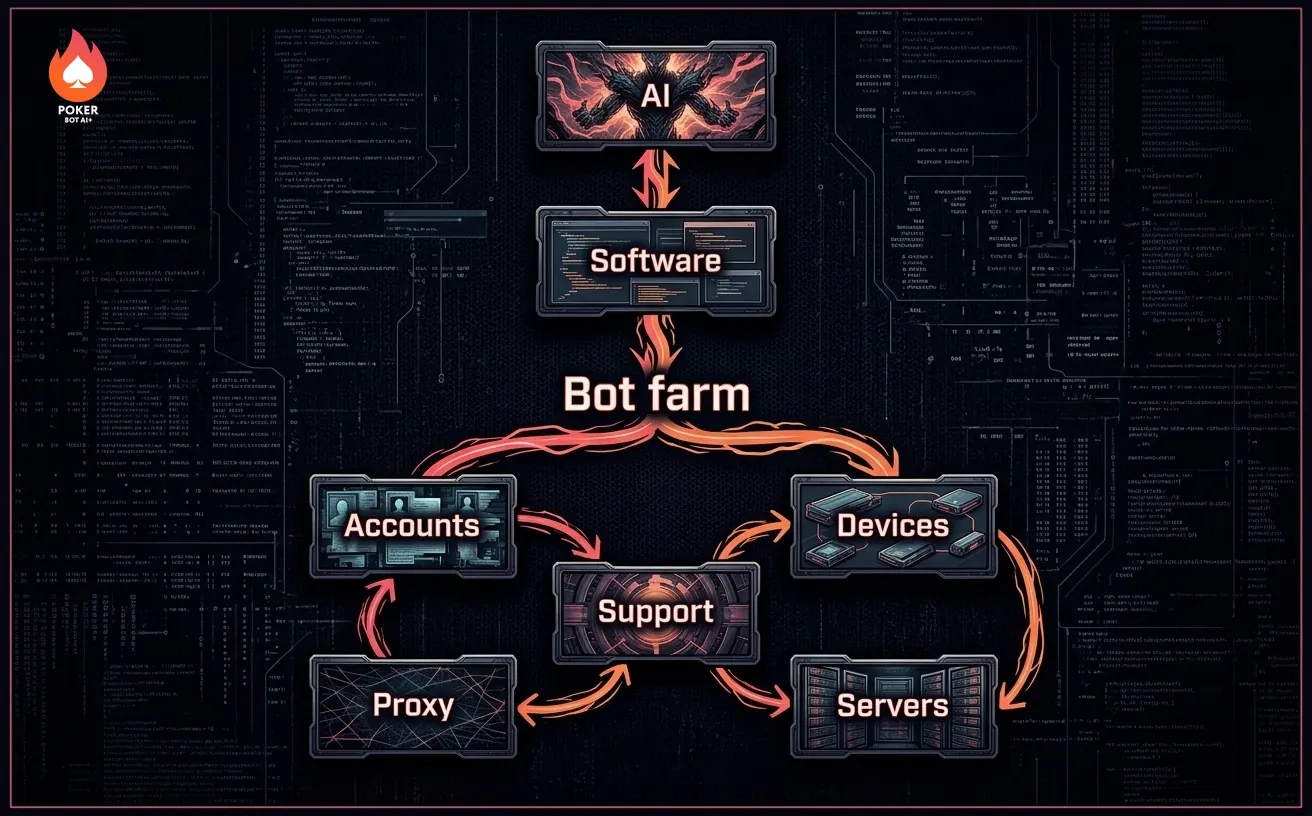
Each account must play on its own device. Multiple accounts on a single device will raise suspicion. Conversely, frequently switching devices within a single account doesn’t bode well. Therefore, it’s advisable to maintain a 1 proxy → 1 account → 1 device setup. And the devices, in turn, should be distributed across servers to ensure stable operation. Now we’ll break down each point individually. And why, in this system, nothing is more important than anything else.
🌐 Proxy
– this is the last thing I would skimp on.
Imagine you’re playing at the 1,000 limit, the pot is 300 BB, you have a nut hand, and you get an all-in. And at that very moment, your proxy crashes and the bot just gets kicked out of the table? Can you picture that? Well, you need to make sure that doesn’t happen.
Proxies for a bot are its connection to the software and AI. They must be clean, run fast, and ensure stable operation at all times while the bot is active.
Proxies deserve their own article, but I think you can Google the differences between the available options on your own and figure out which ones will work for you and which won’t. In short, you need to make sure your accounts aren’t linked to each other. You can’t run all your accounts on a single proxy.
It’s also important to note that all proxy providers will promise to provide clean proxies and that they’ll be exclusively yours. But in reality, the quality and uniqueness of proxies on the market often turn out to be worse than you expect. Your task is to find a proxy provider that suits you personally. I can’t recommend anyone specifically. But I would pay attention first and foremost to customer support—they should be responsive and resolve issues promptly if you’re not satisfied with the proxy quality.
👤 Accounts
Your money won’t be in your bank account or on your card. Your money will be held in accounts. And it makes sense that you need to take their creation as seriously as possible, rather than just registering 10 in a row and running the software. So as soon as you’ve sorted out the proxies, you should learn how to work with accounts.
Each account must be as unique as possible. In the real world, behind every such account is a real person with their own life and history. So you must imagine that you are creating a new identity, not just a username and password. One has no profile picture, another has a standard one, and a third has a photo with his wife and kids. One went all out and bought a set of emojis, while another upgraded to a VIP account. There’s plenty of room here to get creative and let your imagination run wild. The point is to make them all different from one another.
Once you have several accounts, it’s worth starting a spreadsheet that tracks registration time, ID, email, username, proxy, account stats, country of registration, the clubs or apps where they played, and so on. If problems arise, you’ll refer to this spreadsheet first to look for patterns.
For example, a poker room might ban all accounts registered with temporary email addresses or email addresses from a single domain in a single day. And if you didn’t take this into account when creating the accounts, you’ll lose everything at once.
That said, it’s easy to go overboard here. Excessive detail doesn’t always help; sometimes it just overloads you and prevents you from seeing the big picture. The point isn’t to get lost in the tables, but to stay in control. In the long run, it’s not the one with the most data who wins, but the one who keeps their data organized.
💻 Devices
You have two options here: your own physical devices or emulators with proxies.
Before buying a whole batch of phones, get one, two, or three, and figure out which one handles the software without any issues (almost any Android smartphone can handle this, so there’s room to save money and find the best option in terms of value for money).
But no one is asking you to buy real phones for this work. The software emulates their operation perfectly. Therefore, all you need is a server with uninterrupted internet access on which you can keep dozens of emulators running simultaneously.
🖥️ Server
You can rent a server, or you can build one yourself. Some people use their own PC, but personally, I wouldn’t skimp here, and it’s unlikely any of you would be willing to give up using your personal computer in favor of a server farm.
With hardware, the story is much the same as with everything else: as long as the load is light, it seems like there’s plenty of headroom. But as soon as the system expands, that illusion quickly fades.
One of the most common mistakes is trying to squeeze the maximum out of the servers. It’s an understandable desire: you want to get up and running faster, recoup your investment faster, and see the scale faster. But an unstable foundation won’t tolerate overloading. It’s better for 5 accounts to play 10,000 hands in a week than for 10 accounts to play 20,000 hands in 3 days and overload the server.
It’s better to have a smaller volume that runs smoothly and predictably than a configuration that looks powerful until the first crash. That’s why I wouldn’t put all my eggs in one basket and would prefer several weaker servers over a single powerful one.
You can view the minimum server requirements in the "System Requirements" section of this article: PokerBotAI in 5 minutes.
🎛️ Control
Another common misconception is the belief in perfect software that you can configure once, turn on, and never touch again. That doesn’t exist and never will.
I tried running a farm several years ago and just recently. The software has come a long way; many issues have been resolved, and today a vast number of factors are taken into account. But errors and glitches still happen. And even the most well-thought-out solutions may not deliver the expected results if left unmonitored.
That’s why monitoring isn’t paranoia or an unnecessary burden—it’s a normal part of the job. When you don’t understand what’s happening in the system right now, you start finding out about problems too late—only after the consequences have already set in. And the consequences in this business are costly. No one is asking you to monitor every account 24/7. Otherwise, the farm wouldn’t make any sense. But you must have a system for monitoring and maintaining stable operation.
Why the system is more important than AI and software
People talk constantly about the quality of AI, win rates, and game metrics. This is, of course, an important part of the conversation. But I’ve always had a different question: how long does a single account actually last, and what ultimately happens to the results it shows on paper?
Because what’s the point of a system that plays well if, in the end, you can’t sustain those results? You can endlessly criticize the AI’s decisions and think that your profit depends solely on it. But over the long haul, the AI will do everything it can to make as much money as possible. But can your system hold up over that distance? You can endlessly discuss the power of AI, the accuracy of its decisions, and impressive statistics, but all of that loses its value sharply if the system breaks down in real-world trading.
In my opinion, beginners almost always overestimate the importance of AI quality and underestimate the importance of basic discipline. They think that buying a powerful solution is enough—and the rest will fall into place. But in this field, a single minor oversight can cost far more than a few lost all-ins in a row. That is precisely why I believe that what matters here is not a single detail, but the cohesion of the entire system.
There is no part that can be considered secondary. The logic of “this is critical, and the rest will work out somehow” doesn’t apply here. If the structure is poorly built, it breaks down entirely.
Beginner mistakes that kill farms right from the start
There’s a set of mistakes I see all the time. Some of them have already been mentioned above, but here I want to gather them in one place because these are the ones that most often break everything before the system even has a chance to reach a stable operating level.
Chasing scale instead of control
“I want my own farm; I need 50 accounts!!!”
This is probably the biggest mistake. A beginner almost always wants to take everything at once. It seems to them that a slow start is a waste of time. But trust me, you’ll have plenty of work to do even with just ten accounts at the beginning. Once you’re confident you understand every step of the process, you can gradually move forward. When scale grows faster than control, the system starts to collapse like a house of cards.
Underestimating the role of accounts and the environment
“I’ll take the cheapest proxies — as long as they work.”
Many people are willing to spend a long time choosing software, comparing numbers, and discussing technical advantages, yet they treat the backbone of the entire structure as something secondary. This is backwards logic. Proxies, accounts, and servers are the foundation on which the entire farm rests. At the start, it’s better to spend more time building the foundation than to endlessly patch up the consequences of rushing later.
Lack of tracking, reporting, and monitoring
“I’ve launched everything, everything is working, there are no errors — so everything is fine.”
When a person doesn’t have a clear picture of what’s happening, they may think they don’t need to monitor anything, that since everything is running smoothly, they can just sit back and do nothing. But the absence of consequences doesn’t mean the problem doesn’t exist. You’re just lucky so far.
Cutting corners where you shouldn’t
“Why pay more — they all work the same anyway.”
The desire to cut costs at the start is understandable. But in this field, cutting corners early on often turns out to be the most expensive option. When you cut corners where the system needs stability, you aren’t reducing risks — you’re actually piling them up. The basics of safe setup are covered in Masking best practices + launch checklist — read it before going live.
Belief in passive income
“I spent a lot of time and money, got everything up and running — time to relax.”
A poker bot farm is not passive income. Even if the system eventually starts running more smoothly and requires less manual intervention, you don’t reach that state by simply pressing a button. It almost always involves lengthy adjustments, errors, re-configurations, and constant attention to detail.
No backup plan
“I already have 50 accounts, 50 working proxies, 50 devices, a well-established system, and stable profits — what could possibly go wrong?”
If a person doesn’t have a plan for when things go wrong, they aren’t managing risk—they’re just hoping the risk will pass them by. Sometimes that actually happens. But building something serious on that assumption is a bad idea. In this field, the winner isn’t the one who never faces problems, but the one who understands in advance that problems will arise and is almost glad when something goes wrong. After all, every solution to a new problem is another step toward the ideal.
My opinion on poker bot farms in 2026
If you look at it objectively, a poker bot farm in 2026 could indeed be an excellent way to make money. But only for those who, from the very beginning, view it not as a fairy tale about easy money, but as a complex, fragile, and demanding system.
I’ve always been wary of people who approach this topic with just one question: “How much can you make?” Usually, this means the person is only looking at the surface and doesn’t want to see what’s behind the scenes. And what’s behind the scenes is the most important part here. It consists of discipline, patience, constant monitoring, readiness for setbacks, and the ability not to deceive yourself.
You can’t account for absolutely everything. There are too many variables in this field. But it’s worth letting go of illusions from the very start. You need to stop thinking that good software solves everything. You shouldn’t confuse scale with sustainability. You shouldn’t build a system on luck.
And here I come to a simple conclusion. This is definitely not the path for those who want quick money, dislike routine, can’t keep things in order, and expect that after the initial setup, everything will run on its own. It won’t. And if it does, it likely won’t last long.
For everyone else, the main question isn’t whether you’ll be able to build a working system. The main question is whether you have the composure to build it without romanticizing it or deluding yourself. Because by 2026, a poker bot farm is no longer a story about a “clever scheme.” It’s a story about consistency. And this is where most people lose interest, when they realize that this, too, requires work. If you’d rather skip the technical side entirely, there’s also The Deal: profit-sharing partnership — a turnkey poker bot farm where PokerBotAI handles setup and you focus on the bankroll.
Any system wears out over time. This applies to proxies, accounts, devices, servers, and the entire farm as a whole. Proxies need to be renewed or replaced. Accounts need to be periodically replaced with new ones, and you should keep a reserve. Devices and servers aren’t eternal and must be maintained in good working order. And your entire approach to the work shouldn’t be static. The world of poker doesn’t stand still, just like everything else around us. If you already have a stable farm, don’t hesitate to try adding, changing, or improving something.
Related posts
 Blog Bot Farm Corporation, Deeplay, Neo Poker Lab - Who are these? My story who we are, who is Bot Farm Corp, Neo Poker Lab and Deeplay. Guide How much do poker bots cost Poker bot pricing breakdown: license fees, fuel system, proxies, hardware, and hidden costs. Side-by-side comparison of cheap, mid-range, and AI bots. Guide Multi-tabling with bots: risks and optimization Multi-tabling poker bots: optimal table count, teamplay strategy, hardware specs, account rotation, and the most common mistakes that lead to bans.
 Update Interview with the developer of the AI poker bot and advisor PokerX A great interview with one of the coders of Poker Bot AI and PokerX Advisor and Assistant: How to work "Brain" and other questions