OFC Poker AI: Best Bot & Solver for Open-Face Chinese Poker in 2026

Challenges Specific to Open-Face Chinese Poker
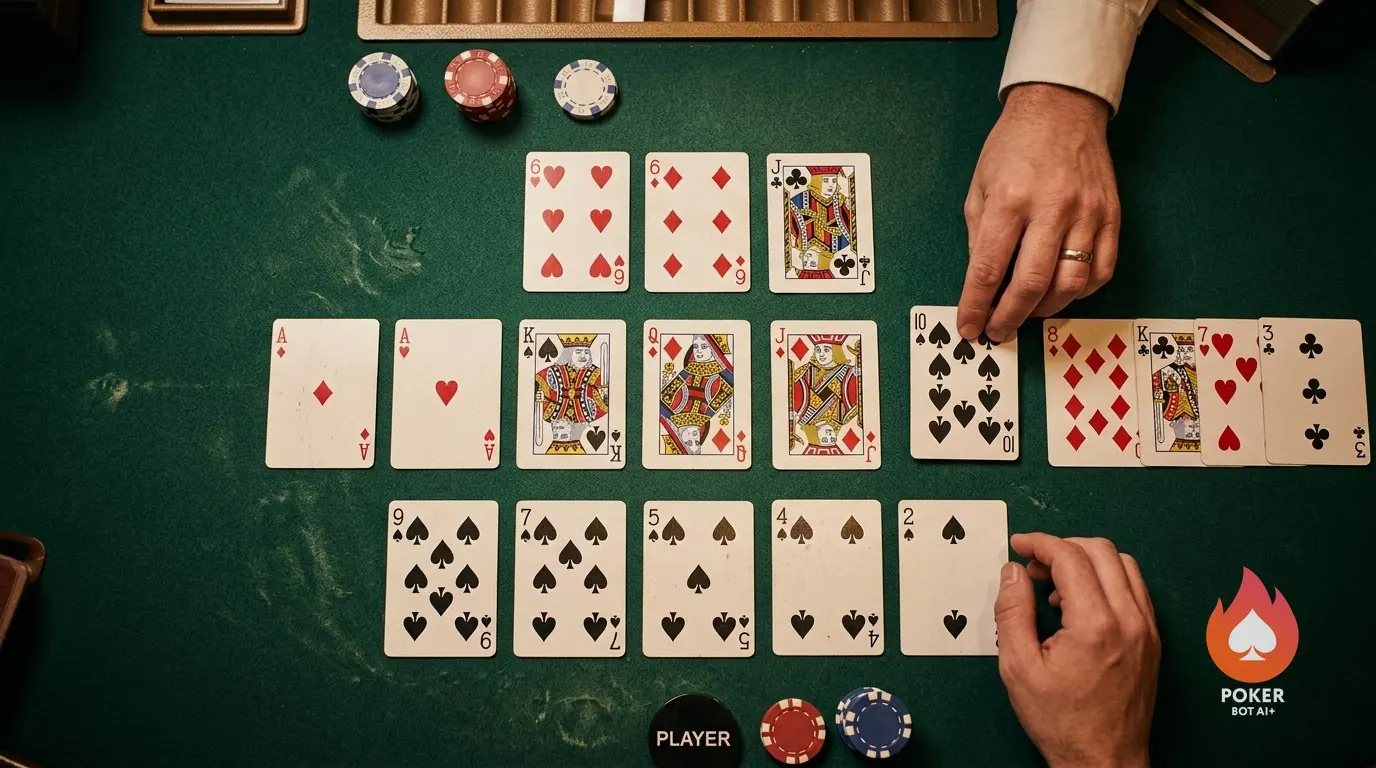
Open-Face Chinese Poker, commonly referred to as OFC, has developed from a mobile-circuit novelty into one of the most analytically demanding variants of poker around. Unlike the more familiar Texas Hold’em and Pot-Limit Omaha, OFC has no betting rounds. Players draw cards and place each card into one of three rows: a three-card “front” row, a five-card “middle” row, and a five-card “back” row. The back must outrank the middle, and the middle must outrank the front. Break that hierarchy and you commit a “foul” — the hand is dead and you concede penalty points to every opponent at the table.
Scoring is what makes OFC different from the rest of poker. Points are awarded for beating an opponent’s row head-to-head, plus a system of “royalties” — bonus points for placing premium hands. A flush in the back is worth meaningfully more than three of a kind in the front; quads, straight flushes and full houses pay escalating bonuses. The one exception is Fantasyland: when a player places a pair of Queens or better in the front without fouling, the next round is dealt as all 13 cards at once and set in private. Fantasyland is one of the biggest information edges in poker, worth several big blinds in expectation.
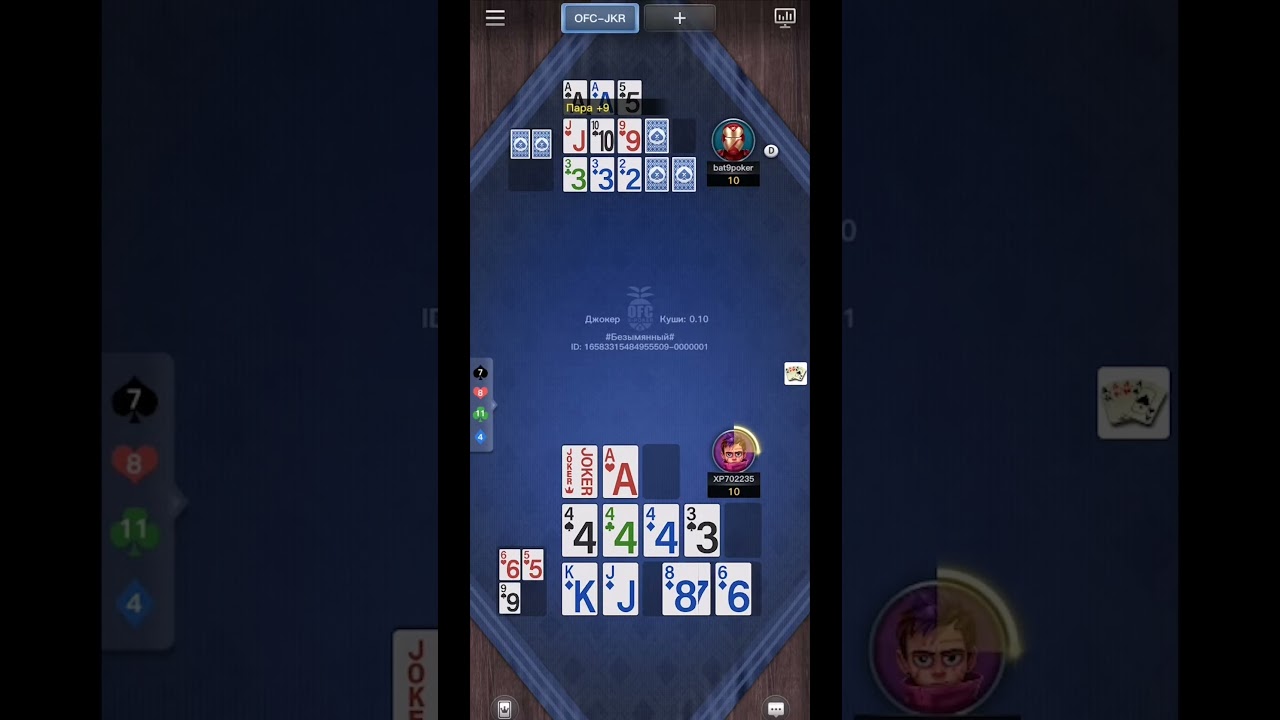
The dominant variant on mobile apps today is Pineapple OFC, in which each player receives three cards per street and discards one. Pineapple compresses the decision tree but raises variance — the discard creates a constant signaling problem and forces tougher draw-versus-value tradeoffs. Most rooms also tighten Fantasyland re-entry to require trips in the front or a full house in the back, to limit the snowball effect that pure-QQ entry would otherwise create.
Why OFC Is Difficult for AI
OFC looks simple but is deceptively complex from a game-theoretic standpoint. There is no opponent-modeling shortcut around betting frequencies, because there are no bets. Every decision is a sequential card-placement problem against an evolving multi-row constraint, with payoffs that only resolve at showdown after every opponent has finished setting. The branching factor is large — by the third street a player faces dozens of legal placements per card — and the reward signal is sparse and delayed.
That is exactly the regime where general-purpose poker solvers struggle. Modern Hold’em and Omaha solvers lean heavily on counterfactual regret minimization (CFR) over abstracted betting trees; OFC has no such tree to abstract. Strong OFC engines rely instead on massive Monte Carlo rollouts paired with neural value networks trained via self-play. The discipline is closer to AlphaZero-style learning than to traditional CFR-based poker solving — pattern recognition over an exploding state space, not regret-minimization over a betting graph.
PokerBotAI’s OFC Engine
PokerBotAI’s flagship engine, PokerX, supports Open-Face Chinese Poker as a first-class variant alongside No-Limit Hold’em and PLO4/5/6. The OFC engine is not a generic model squinting at a different rule set — it is a dedicated specialist trained on its own data.
Under the hood, PokerX runs on PokerBotAI’s TriBrain Engine, a three-component architecture:
- Hand History — a database of opponent histories used to build a precise profile of every player at the table.
- Neural Network — a self-learning model trained on 7+ billion synthetic and solver-generated hands plus 300+ million real hands collected from rooms since the 2000s. This is the component that makes the core placement decisions.
- Experts — algorithms layered on top of the neural network for specific situations (multiway, short deck, deep stack, atypical Fantasyland entries) where pure neural-net play leaves edge on the table.
The detail that matters for OFC is that PokerBotAI does not run one universal “brain” across all formats. A separate specialized model is trained for each game type — NLH, PLO, OFC — and further tuned per stakes, room and field geography. The OFC model is fine-tuned against the play traces of experienced OFC professionals using genetic algorithms and live-table testing, with monthly retraining cycles. The compute backend runs on Nvidia Tesla GPUs (T4, 16 GB VRAM) — datacenter hardware, not a hobbyist setup.
The result is an engine with a measurably higher win rate than the older generation of OFC tools on the market. In a controlled 150,000-hand sample, PokerX outperformed both NZT and Warbot — the two engines most often cited as benchmarks in the OFC community. The gap was widest in two areas where rule-based engines historically leak value: marginal Fantasyland-entry decisions and deep-stack foul-avoidance. PokerX handles those decisions probabilistically, weighing the equity of attempting Fantasyland with a borderline QQ-front against the foul risk that comes with it, given the cards already locked and the configurations the opponents are showing.
The engine is integrated with the major mobile poker clients where OFC has critical mass:
For PPPoker, X-Poker and PokerBROS, PokerX runs directly on smartphones. On the other clients it runs via the LDPlayer Android emulator on Windows 10+, which is also the recommended primary setup for scaling to multiple accounts. Each room is operated as a separate vision-and-action pipeline tuned to that client, which is why PokerBotAI’s app coverage is narrower than its raw model strength would suggest. Players can run PokerX in Auto Mode (fully autonomous play given stake, stop-loss and timing parameters) or Manual Mode (the engine provides decisions while the player executes), with the choice driven by the rules of the specific club.

How Strong OFC Strategy Differs from Hold’em
Three principles separate winning OFC play from losing OFC play, and they are the principles a serious engine has to internalize:
Foul-rate management. A 5–8% foul rate is normal for an aggressive player; above 12% and the leak is severe. The discipline is in knowing when to lock in a guaranteed scoring hand versus when to gamble on completing a row.
Royalty hunting at the right moment. Royalties are non-linear: the gap between a no-royalty back and a flush back is much larger than the gap between a flush back and a full house back. Strong play attacks the early thresholds and only chases the high-value royalties when the cost of doing so is low.
Fantasyland equity is enormous and decision-distorting. The expected value of entering Fantasyland with a typical setup is on the order of several big blinds. Players consistently underprice the entry and overprice the risk. A good engine will push for QQ-front placements that intuitively feel reckless because the EV math is one-sided.
PokerBotAI’s engine surfaces these decisions explicitly. Used as a solver after a session, it labels each placement with its EV delta relative to the engine’s preferred move — the same review loop that drove the modern wave of Hold’em improvement after public GTO tools matured.
Solver, Not Cheat
To be explicit: PokerX is not a “PPPoker cheat” and the project is not marketed to that audience. It is an analysis and decision-support tool in the same category as the major Hold’em and Omaha solvers used by professionals. Players use it to review hands after a session, to study Fantasyland-entry thresholds against specific opponent pools, and in live-assistance mode where the local club’s rules and the operator’s terms allow.
The serious user base for PokerX is professional OFC players in private clubs, where the standard of play is high enough that intuition alone leaves obvious money on the table. For those players, having a quantitatively rigorous second opinion on every placement is the difference between break-even and a real win rate.
If you play OFC regularly and want to see what your game looks like against a modern engine, contact the PokerBotAI team through the official site. New users get a free evaluation period to run their own hands through the tool.
Interested in playing poker with AI? Join us on Telegram — our team will set you up with a free trial and walk you through the OFC workflow.
Frequently Asked Questions
1. What makes OFC different from other poker variants?
There are no betting rounds. Cards are placed into three ranked rows and points are scored by row comparison and royalty bonuses. The game is closer to a card-placement puzzle with delayed reward than to a betting game, which is exactly why it demands a different class of AI engine.
2. Which apps does PokerX OFC support?
PPPoker, X-Poker, Pokerrrr2, Suprema Poker, Fishpoker, and PokerBROS. Coverage expands as integrations are validated against new client UI revisions.
3. Is using OFC analysis software cheating?
No — used as a study and review tool, PokerX is in the same category as the Hold’em and Omaha solvers professional players have used for years. How the tool is used in live play is governed by the specific club’s rules and the operator’s terms of service, which is the user’s responsibility to respect.
4. What kind of edge does the engine actually have?
In a controlled 150,000-hand sample, PokerX outperformed both NZT and Warbot, with the largest gaps in Fantasyland-entry decisions and in deep-stack foul-avoidance. Edge over a strong human player is smaller but still consistent across a wide enough sample.
5. Does it handle Pineapple OFC specifically?
Yes. Pineapple is the dominant mobile format and the engine is trained natively on Pineapple discard dynamics rather than running a converted classic-OFC model.
6. How do I get started?
Contact the PokerBotAI team through the official site. Onboarding includes a guided evaluation and configuration of the engine for the specific app and stakes you play.
Learn more about us in the Knowledge Hub: Featured Articles on Poker Bot
Related posts

 Blog What to Learn About Libratus Poker Bot? In this article, you will know what is the Libratus poker bot? Please read this.
  Blog Warbot pokerbot review Warbot is an Open Hold‘em-based, customizable and programmable poker bot, which plays according to loaded profile.
  Blog Build a Custom Poker Assistant in 10 Steps Step-by-step guide to build a poker assistant in 2025: choose tech stack, clean data, solver integration, exploit tracking, and ethical play.